
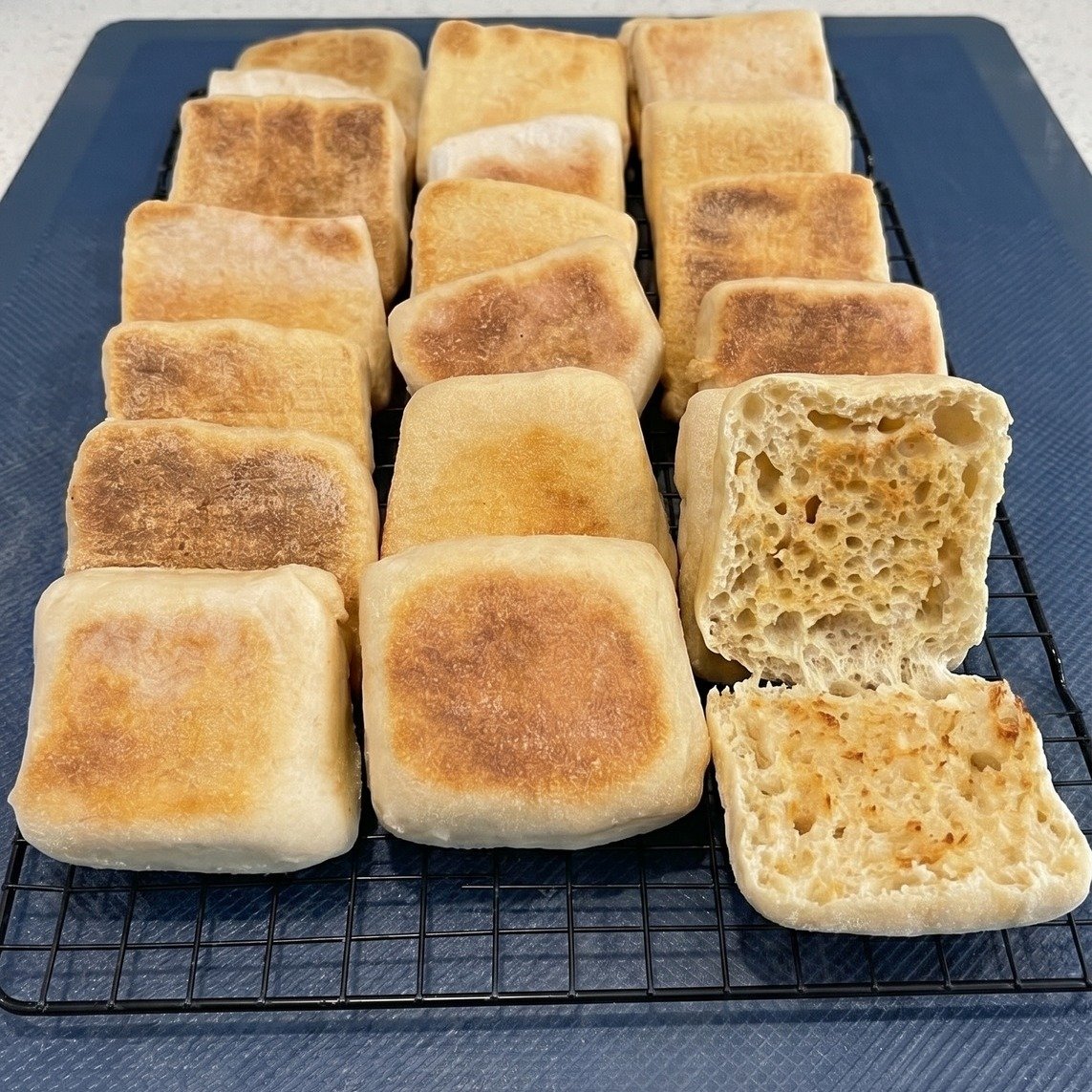
Forget Round Muffins — Square Is The Move
Hot take? Round English muffins are low-key overrated.
Yeah, they look cute sitting in the bakery case, but when you’re making homemade sourdough English muffins, round cutters are honestly a pain. You cut circles, then you’re stuck with random dough scraps drying out on the counter like sad little leftovers nobody wants to deal with.
Not anymore.
Square sourdough English muffins are the smarter flex.
No rerolling.
No wasted dough.
No weird uneven muffins from overworked scraps.
Just straight-up golden, fluffy, buttery breakfast perfection.
And honestly? Once they’re toasted, loaded with butter, stacked with eggs, or turned into breakfast sandwiches… nobody cares if they’re square.
Actually, they kinda hit harder.
These no-waste sourdough English muffins come out soft in the middle, crispy around the edges, and packed with that signature tangy sourdough flavor everybody loves.
Perfect for meal prep.
Perfect for breakfast sandwiches.
Perfect for people who are tired of wasting dough every single batch.
Why Square English Muffins Just Make More Sense
Traditional round cutters waste dough. Period.
You cut circles, then reroll the scraps, which sounds harmless… until the rerolled dough turns dense, chewy, and uneven. Those second-round muffins never cook the same.
Square muffins fix all of that.
You simply shape the dough into a rectangle and slice straight lines across it.
Boom.
Every piece becomes an English muffin.
No scraps.
No rerolls.
No drama.
More muffins from the exact same batch.
That’s kitchen math we actually respect.
Why You’ll Be Obsessed With This Recipe
- Zero dough waste
- Soft, airy centers
- Crispy cornmeal crust
- Naturally fermented sourdough flavor
- No commercial yeast needed
- Meal-prep friendly
- Freezer friendly
- Perfect for breakfast sandwiches
- Beginner-friendly process
- Crazy good toasted with butter
Recipe Overview
Yield: 8–10 square English muffins
Fermentation: Overnight sourdough rise
Cook Method: Covered skillet or griddle
Texture: Fluffy inside with crispy golden edges
Flavor: Mild tang, buttery finish, toasted cornmeal crunch
Best For: Breakfast sandwiches, avocado toast, eggs, jam, honey, burgers, mini pizzas
Ingredients
- 100g active sourdough starter
- 240g whole milk
- 20g honey, maple syrup, or sugar
- 360g all-purpose flour
- 5g salt
- Cornmeal for dusting
Ingredient Breakdown
Active Sourdough Starter
Your starter should look bubbly, active, and recently fed.
It doesn’t have to be at peak “Instagram starter” status, but it should have enough strength to ferment overnight.
Weak starter = dense muffins.
Strong starter = fluffy breakfast magic.
Milk
Milk gives these English muffins a softer texture and richer flavor than water ever could.
That’s what creates that classic soft breakfast bread vibe everybody wants.
Sweetener
Honey, maple syrup, or sugar all work here.
Each one changes the flavor slightly:
- Honey = cozy warmth
- Maple syrup = deeper flavor
- Sugar = clean and classic
It also helps the muffins brown beautifully on the skillet.
All-Purpose Flour
AP flour keeps the texture soft and tender.
Bread flour works too, but it creates a chewier muffin.
For classic diner-style English muffins? All-purpose is the winner.
Cornmeal
Cornmeal does two important things:
- Prevents sticking
- Creates that iconic crispy English muffin crust
That toasted cornmeal bottom is elite.
How To Make Square Sourdough English Muffins
Step 1: Mix The Dough
In a large bowl, combine:
- Active sourdough starter
- Milk
- Honey, sugar, or maple syrup
Whisk until the starter loosens into the milk.
Add the flour and salt.
Mix everything together until no dry flour remains and a shaggy dough forms.
The dough should feel soft and slightly sticky — not stiff.
Cover the bowl and let it rest for 30–60 minutes.
This rest period helps hydrate the flour and makes kneading way easier later.
Step 2: Knead Until Smooth
After resting, knead the dough for about 5 minutes.
You can:
- Knead by hand
- Use a stand mixer with a dough hook
The dough should become smoother, stretchier, and easier to handle.
Don’t dump in tons of extra flour.
A little flour is fine, but too much will dry the muffins out.
Step 3: Overnight Fermentation
Transfer the dough into a lightly greased bowl.
Cover and let ferment overnight at room temperature for 8–12 hours.
By morning, the dough should look:
- Puffy
- Soft
- Slightly risen
- Alive
It may not fully double, and that’s totally fine.
Warm kitchens ferment faster.
Cool kitchens need more time.
If your house runs warm, check the dough earlier so it doesn’t overproof.
Step 4: Shape Into A Rectangle
Turn the fermented dough onto a lightly floured surface.
Gently press it into a rectangle about ½ inch thick.
Don’t aggressively flatten it.
You want to keep those beautiful fermentation bubbles inside the dough.
Use light pressure with your hands or a rolling pin.
Step 5: Cut Into Squares
Here’s where the no-waste magic happens.
Using a bench scraper, pizza cutter, or sharp knife, cut the dough into squares.
Straight lines only.
No scraps.
No rerolling.
Transfer the squares onto a cornmeal-lined baking sheet.
Dust the tops lightly with more cornmeal.
That’s it.
You just turned every inch of dough into breakfast.
Step 6: Final Rest
Cover the cut muffins and let them rest for about 1 hour.
This second rise helps them puff up and relax after cutting.
Don’t skip it.
That little rest is what helps create lighter, fluffier English muffins instead of dense hockey pucks.
Step 7: Cook Low And Slow
Heat a skillet or griddle over LOW heat.
Not medium.
Not medium-high.
LOW.
English muffins need time to cook through before the outside browns too hard.
Place the muffins onto the skillet and cover with a lid.
Cook about 4 minutes per side until golden brown.
The internal temperature should hit 200°F.
If the outside gets dark too fast, your heat is too high.
Low and steady wins this game.
Why Covering The Skillet Matters
Covering the skillet traps heat like a mini oven.
That trapped steam helps cook the inside while the outside slowly turns golden and crisp.
Without the lid, the centers can stay raw while the bottoms burn.
Honestly, the lid trick changes everything.
How To Split English Muffins The Right Way
Never slice English muffins with a knife if you want maximum texture.
Use a fork instead.
Poke around the edges, then gently pull them apart.
That creates those iconic craggy edges that hold melted butter, jam, eggs, and cheese like absolute champions.
Fork-splitting is the real secret.
Best Ways To Eat These
These square sourdough English muffins go crazy with:
- Butter and jam
- Fried eggs
- Bacon sandwiches
- Sausage patties
- Avocado toast
- Cream cheese
- Peanut butter
- Honey drizzle
- Breakfast burgers
- Mini pizzas
- Soup dipping
Always toast them first.
That crispy outside + soft inside combo is unreal.
Storage Tips
Let the muffins cool completely before storing.
Keep them in an airtight container for 2–3 days at room temperature.
For longer storage:
- Split them first
- Freeze them
- Toast straight from frozen
Super easy meal prep move.
Troubleshooting
Why Are My Muffins Raw Inside?
Your skillet was probably too hot.
Cook lower and slower with the lid on.
Why Did They Turn Out Dense?
Usually caused by:
- Weak starter
- Under-fermentation
- Skipping the final rest
Why Did They Burn?
Heat was too high.
English muffins are a patience recipe.
Why Was My Dough Sticky?
A little stickiness is normal.
Lightly flour your hands if needed, but don’t overload the dough with flour.
FAQ
Can I Make These Without Commercial Yeast?
Yep. This recipe is 100% naturally leavened with sourdough starter only.
Can I Use Bread Flour?
You can, but the texture will be chewier.
All-purpose flour gives the softest classic texture.
Can I Still Make Them Round?
Of course.
But square muffins are faster, easier, and waste less dough.
Do I Need Cornmeal?
Highly recommended.
It prevents sticking and creates that classic crispy crust.
Can I Cold Ferment The Dough?
Absolutely.
You can refrigerate the dough overnight for a slower fermentation and deeper flavor.
Full Recipe Card
Square Sourdough English Muffins
Yield
8–10 muffins
Prep Time
25 minutes
Fermentation Time
8–12 hours
Final Rest
1 hour
Cook Time
8 minutes per batch
Total Time
About 10–14 hours
Ingredients
- 100g active sourdough starter
- 240g milk
- 20g honey, maple syrup, or sugar
- 360g all-purpose flour
- 5g salt
- Cornmeal for dusting
Instructions
- Mix starter, milk, and sweetener together.
- Add flour and salt. Mix into a rough dough.
- Cover and rest 30–60 minutes.
- Knead for 5 minutes until smooth.
- Ferment overnight for 8–12 hours.
- Press dough into a ½-inch rectangle.
- Cut into squares.
- Transfer onto cornmeal-lined tray.
- Rest 1 hour.
- Cook covered on low heat for about 4 minutes per side.
- Cool slightly.
- Split with a fork, toast, and serve.
Final Thoughts
Square sourdough English muffins are low-key genius.
You still get that fluffy interior, crispy toasted crust, and tangy sourdough flavor everybody loves…
But without wasting half your dough on scraps.
No rerolling.
No weird leftovers.
No extra hassle.
Just golden homemade English muffins ready for breakfast sandwiches, melted butter, jam, or whatever breakfast combo you’re craving.
Once you make them square, going back to round honestly feels unnecessary.